
A Roadmap for the Pilates Instructor Journey
One of the most common mistakes Pilates instructors make is assuming that the challenges they are experiencing are unique to them.
They believe they are struggling because they are not talented enough, not confident enough, or not working hard enough.
In reality, most instructors are simply experiencing the predictable challenges that arise at a particular stage of development.
The purpose of this framework is to help you understand where you are, what problems are normal at that stage, and what you need to focus on next.
This model has been built from thousands of hours of observation, mentoring, coaching and conversation with Pilates instructors across a wide range of studios and teaching environments.
It is not a scientific model. It is a practical model.
And while every instructor’s journey is slightly different, the pattern appears remarkably consistent.
The framework is based primarily on teaching hours rather than years of experience. Some instructors teach five hours per week. Others teach twenty-five. Teaching exposure matters more than time elapsed.
The question is not:
“How long have you been certified?”
The question is:
“How many hours have you actually spent standing in front of clients solving teaching problems?”
The Four Stages
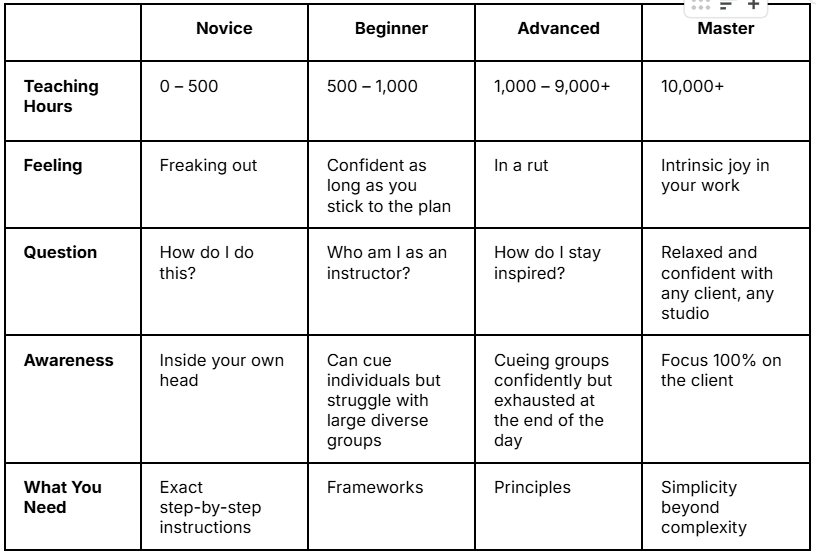
Stage 1: The Novice | Teaching Hours: 0–500
For most instructors this represents roughly the first year of teaching.
If you teach 10–15 classes per week, you’ll accumulate approximately 400–600 teaching hours over a year.
At this stage the dominant feeling is often anxiety.
Not because you are incompetent. Because teaching is more complicated than it appeared during training.
You are no longer teaching classmates who share your enthusiasm for Pilates.
You are teaching real people.
People arrive late. People have injuries. People ask unexpected questions. People forget what you said thirty seconds ago. People move differently than they did in the assessment.
Everything feels less predictable than it did in teacher training.
The Core Question
The novice asks: How do I do this?
How do I teach this exercise?
How do I answer that question?
How do I manage fifteen people at once?
How do I remember the sequence?
How do I know if someone is doing it correctly?
Where Your Attention Lives
At this stage your awareness is mostly internal.
You are thinking about:
-
What you should say next.
-
Whether you’re doing a good job.
-
Whether clients like you.
-
Whether you forgot something.
This is completely normal.
The cognitive load is enormous because almost every teaching skill still requires conscious effort.
What You Need
You do not need freedom. You do not need creativity. You do not need endless exercise variations.
You need:
- Exact step-by-step instructions.
- A clear lesson plan.
- A clear sequence.
- Clear expectations.
- Clear cueing.
- A repeatable process.
Many instructors resist structure because they believe it limits creativity. In reality, structure creates the conditions for future creativity.
The fastest way out of the novice stage is not more freedom. It is better systems.
Stage 2: The Beginner | Teaching Hours: 500–1,000
At this point you have accumulated enough repetitions that teaching begins to feel more natural.
You can generally run a class without panicking. You know your exercises. You know your studio. You know what usually happens.
The Feeling
You are confident… As long as everything goes according to plan.
When the expected clients arrive. When nobody gets injured. When nobody asks an unusual question. When nobody presents with a challenge you haven’t seen before.
The moment the script breaks, your confidence can disappear.
The Core Questions
The beginner often starts asking deeper questions: Who am I as an instructor?
What kind of teacher do I want to become? Do I actually enjoy teaching here?
Many instructors begin working across multiple studios during this phase.
For the first time they encounter different cultures, different expectations and different teaching philosophies.
They begin discovering what aligns with them and what does not.
Where Your Attention Lives
Your awareness is no longer entirely internal. You can now see individual clients clearly.
You can often solve problems one-on-one.
The challenge is managing diversity.
You can help one person. You struggle to help fifteen different people simultaneously. This is where group teaching becomes a distinct skill.
What You Need
Step-by-step instructions are no longer enough.
The real world is too varied.
You need:
Frameworks.
Frameworks allow you to solve categories of problems rather than individual situations.
Examples include:
-
Layered progressions.
-
Cueing systems.
-
Programming systems.
-
Observation frameworks.
-
Decision-making models.
Frameworks create flexibility without creating chaos.
This is where most serious professional development becomes valuable.
Stage 3: The Advanced Instructor | Teaching Hours: 1,000–9,000+
This is by far the longest stage. Many instructors spend years here.
You have become competent. Clients trust you. Studios trust you.
You can teach almost any class that appears on the schedule.
The Hidden Problem
At first, this feels fantastic.
The systems work. The frameworks work. You can manage groups confidently. You can handle unexpected situations. You can solve problems quickly.
Then something interesting happens.
The things that once excited you become familiar. The frameworks that helped you grow start to feel repetitive.
You find yourself asking: “What’s next?”
The Core Question
The advanced instructor asks: “How do I stay inspired?”
Not because they are failing. Because they have become competent.
The challenge is no longer survival. The challenge is meaning.
Where Your Attention Lives
You are capable of teaching large groups effectively.
Clients get good results. Classes run smoothly.
But there is often a cost.
Many instructors at this stage become exhausted. Not because they are bad teachers. Because teaching twenty or thirty hours per week is demanding.
You are constantly:
-
Observing.
-
Coaching.
-
Managing energy.
-
Solving problems.
-
Making decisions.
Eventually this creates fatigue.
What You Need
You need something deeper than frameworks.
You need: Principles.
A framework tells you what to do. A principle tells you why it works.
A framework is: “Teach long stretch this way.”
A principle is: “Choose a variation that allows everyone to experience meaningful challenge.”
Once you understand principles, you can adapt endlessly.
This is also the stage where many instructors begin mentoring others. And something fascinating happens.
A new instructor asks a question.
You answer.
They stare at you blankly.
Why?
Because you’re now thinking in principles while they still need step-by-step instructions.
That gap is often one of the clearest signs that you’ve progressed beyond the beginner stage.
Stage 4: Mastery | Teaching Hours: 10,000+
Relatively few instructors reach this stage.
Not because it is impossible but because many leave the profession before accumulating enough meaningful practice.
The Feeling
The defining characteristic is not expertise. It is peace.
You stop chasing novelty. You stop searching for the next big thing. You stop needing external validation.
Instead, you begin finding joy in depth.
The same movements. The same class structures. The same teaching challenges.
Explored at a deeper and deeper level.
The Core Experience
The master instructor is comfortable teaching:
-
Any client.
-
Any class.
-
Any studio.
-
Any environment.
Not because they know everything. Because they understand the underlying principles deeply enough to adapt.
Where Your Attention Lives
This is perhaps the most important shift in the entire model.
The novice is focused on themselves. The master is focused entirely on the client.
Their internal dialogue becomes quiet. Teaching becomes fluid. Decision-making becomes intuitive.
Their attention is available for the people in front of them.
They can see more. Respond faster. Adapt effortlessly.
What You Need
The final requirement is: Simplicity beyond complexity.
This is difficult to explain because it is something that must be experienced.
The master often appears simple. Their classes appear simple. Their cueing appears simple. Their programming appears simple.
But that simplicity sits on top of thousands of hours of complexity.
The simplicity is not ignorance.
It is integration.
