Knowing when to move someone on
One of the challenges of teaching a group is that people don’t arrive at the next layer together.
You might have someone who’s been coming consistently for a year alongside someone who’s been in and out for the last few months. The first person needs more challenge. The second still has plenty to work on where they are.
You can say, “Stay here if this is where you need to be today,” but that doesn’t necessarily solve it. Some people will stay when they could do more. Others will take every progression you offer, whether they can manage it or not.
Michelle’s question was about that decision: when do you keep adding layers, and when do you stop people from coming with you?
This is where “tell, don’t ask” comes in. But before you can tell someone to move on, or tell them to stay where they are, you need to know what you’re looking at. The framework that makes that possible is reading the reps.
Reading strength, skill and balance
You’re looking at how the movement changes across the set. Can the person manage the load? Have they got the range of motion? Do they understand what they’re trying to do? And as they keep going, does their movement get better or worse?
What those changes tell you depends on the challenge you’ve set.
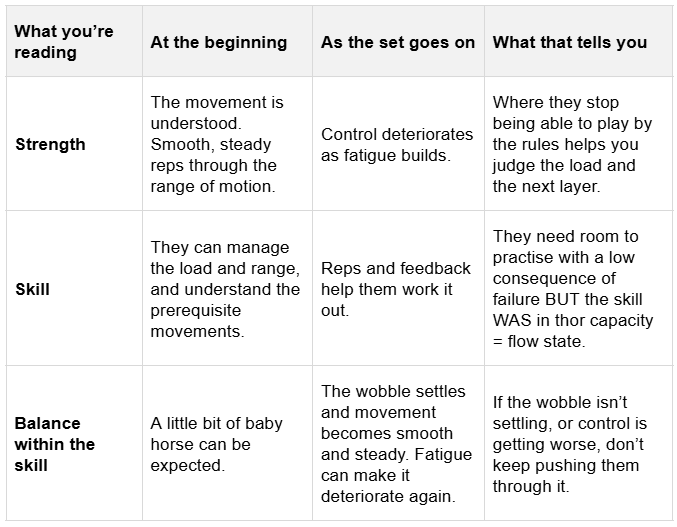
When you’re working on strength, you want the movement to be understood at the beginning. You want range of motion, smooth and steady reps, and enough control that the person can play by the rules of the movement. As they fatigue, that control starts to deteriorate.
The useful information is where that happens. In the push-up example we’d been discussing, I was looking for fatigue somewhere around 15–25 reps. That was the target for that particular task. If someone was still moving smoothly through the full range, I had information I could use when we came back to it.
Skill requires a different reading. Before you introduce the next layer, you need to be confident that the person can manage the load, has the range of motion, and understands enough of the prerequisite movements to work out what you’re asking.
You also need a low consequence of failure. They need room to get it wrong, do some reps, receive some feedback and get better, without hurting themselves or becoming so demoralised that they stop trying.
When balance is involved, you might expect a little bit of baby horse at the beginning. That’s fine. But you want it to become smooth and steady pretty darn quick. If they’re still really wobbly at rep seven or eight, they’re probably going to end up on their ass.
So the pattern matters. With a strength challenge, you’re looking for control that deteriorates as fatigue builds. With a skill or balance challenge, you’re looking for the initial difficulty to settle as the person works it out. Keep going long enough and fatigue will make that movement deteriorate too. You need to recognise when the useful practice is over.
And these challenges overlap. Pushing the bed out, dropping the hips, lifting the hips and bringing the bed back requires strength and skill. The more tired I get, the stupider I become. “Keep going” isn’t automatically useful coaching.
Watch: Reading the reps
What you are looking for
Making the next decision
Reading the reps becomes useful when it changes the instruction you give next.
Take Michelle’s sequence. Everyone starts on one spring, feet on the platform, hands on the carriage. Establish the movement, then add the hips dropping and lifting as the bed moves out and back.
Now watch what happens.
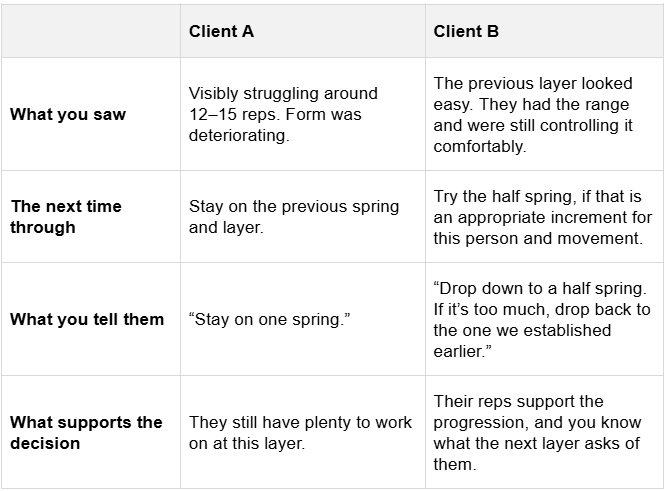
If one person is visibly struggling around the 12–15 rep mark, there’s your answer for the next time through. They have plenty to work on. They don’t get a hall pass to the next layer just because the person beside them does.
Someone else might make the same layer look easy. They understand the movement, have the range and are still controlling it comfortably. If you know that reducing the spring is an appropriate next increment, you can tell that person to try it.
Same movement, half spring. That’s the power of the reformer: change the spring tension and you change the input.
You don’t need to keep the whole group there until everyone is exhausted. In this example, we’re working with a range of motion movement; we don’t need to turn it into a 25-rep hypertrophy set. Do some squats, lunges or whatever else belongs in the sequence, then use what you observed when you return.
Client A stays on the previous spring. Client B tries the lighter spring. Both decisions come from what happened in the previous set.
Same group, different instructions
This is why knowing your layers matters so much. Seeing that someone has more to give is only half the decision. You also need to know what you’re asking them to do next and be confident that it’s an appropriate increment.
That confidence comes from knowing your gear, teaching the layers all the freaking time and watching how people respond to them. You’re building your ability to predict.
When you see someone complete good reps through the range, you can say, “Next time, try this.” You can also give them a way back: “If it’s too much, drop back to the one we established earlier.”
That’s a much more useful instruction than leaving everyone to decide whether they fancy a challenge.
Owning the room
It also requires you to own the room.
Christina and I had this conversation because she kept offering, offering, offering. At a certain point, I said, “You’ve got to own the fucking room.” If you know the layers and can read the reps, you need the confidence to act on what you’ve seen.
Sometimes that means telling someone they can do something they didn’t know they could. Sometimes it means saying, “Not yet, buddy.”
If I tell Katie to try shoulder bridge on a half spring and the person beside her starts changing their springs too, I’m going to stop them if they can’t get their hips off the bed on full springs. Katie’s progression isn’t evidence that they’re ready for it.
Watch: Owning the room
Being clear about that doesn’t prevent you from recognising what the person does well. Katie made this point in the conversation: if you feel bad holding someone back, find something else they do well and acknowledge it.
Strength, range of motion and control aren’t distributed equally. The very strong client might struggle with a movement that the more flexible, coordinated person beside them makes look easy. Later, when you get to push-ups, that same client might be a killer. You can recognise both things.
Confidence and choice
I know this approach runs against a lot of the language in Pilates education: do what you feel, take more challenge if you want it. But wanting more challenge doesn’t tell you whether someone can manage it. They may become so occupied with trying to survive the movement that they never get the repetitions that would help them become more efficient.
“Tell, don’t ask” still leaves room for choice. You’re giving someone a recommendation you have good reason to make:
“I’m very confident you can do this. Give it a try. If you don’t like it, don’t do it.”
The responsibility sits in knowing your stuff. What challenge are you offering? What changes when they take it? What are the consequences of that choice?
Your clients don’t need a lecture on every muscle affected by half a spring versus two and a half springs. They need enough information to succeed. You need enough understanding to give them the right instruction, watch what happens and make the next decision.
